This weekend I saw the movie Babel. Spoiler Alert: If you don't want to know anything about it, stop reading!!
If you haven't heard about it, it follows the interrelated stories of various families in different countries. They are separated by misunderstandings - barriers of language and culture. Yet they all face the same feelings of love and grief. Reviews tend to compare it to last year's "Crash." They also tend to refer to a character as "a deaf-mute teenager."
The movie itself was pretty good. It was kinda long and I wished I had waited to rent a DVD of it, but I wasn't displeased during the showing. Plus, it brings up interesting issues of disability representation and language.
Part of the movie follows Chieko, a Deaf girl in Japan. She is very rebellious and sexual.
Many reviews seem to think she's hypersexual and frustrated because she is Deaf. While she does get upset at the way a group of hearing people mock her and her Deaf teammates ("They look at us like we're monsters"), we find in the movie that there are other reasons for her discontent. That does not stop many reviewers and probably many movie-goers from thinking her deafness, at least in part, causes her behavior.
"the young deaf Chieko, rebelling because of her handicap" -indieWIRE
"a deaf-mute teenage girl named Chieko batters against the wall of her isolation" -Boston Globe
"a deaf-mute Japanese teenager who's struggling to adjust to her handicap" -Seattle Post Intelligencer
etc. etc.
Also, most of the reviews I read refer to Chieko as "deaf-mute." In the film, she and her friends refer to themselves as "deaf-mute" (at least in translated subtitles). However, that term remains an offensive one, at least here in America. I wonder if the reviewers knew this and decided to stick with "deaf-mute" because it is used in the movie. Is it an accepted term in Japan? If the word "Negro" was used in a movie to refer to a character of African origin, would reviewers use the same word to refer to the character in their review? Or would they understand that the word is now considered to be a slur and a means of oppression, and use another term?
Moving on. In the movie, Chieko goes out with friends dancing at some sort of wild/crazy/sweaty/colorful/loud/busy disco place. (Ps. why aren't dance clubs as fun in real life as they are in the movies?) These scenes are full of flashy colors and loud noises. Then the sound cuts out, leaving the audiences eyes swimming and ears burning with silence. Slate explains it as: "a bravura nightclub sequence in which we alternate between the pulsing music of the strobe-lit dance floor and the silence of Chieko's inner experience."
Ohhh. That is what it must be like to be deaf-mute-handicapped-deformed. Because she cannot hear, she can never experience the joy of her peers. She is trapped in a quiet world, lonely to the core. No wonder she does not behave. Pity her, for you would act out, too, if you had to endure such a tragedy.
So obviously, it bothered me a bit. The first time this technique was used in the movie, I didn't mind. It was a reminder that not everyone experiences the world the same way, and I didn't perceive it as negative. But then they did it over and over while Chieko grew sadder and more isolated, and then left the club. The Denver Post describes it as "a powerful gesture that elicits your physical empathy before sending you away from the lonesome teen to enjoy the waves of sound."
For the record, most Deaf people understand sound very well. They live in a world with sounds and with people who value these sounds greatly. It is a stereotype that Deaf people "live in a world of silence." Many can appreciate some sounds at certain pitches/volumes. Sometimes they can feel the vibrations sounds cause. They certainly see the effects of sound (for example, hearing people asking them not to laugh or make other sounds because it sounds like animals).
Apart from all of this, I thought it was fun to see Japanese Sign Language in a movie. However the Boston Globe isn't sure JSL counts as a true language, saying, "the Language -- and there are six of them in "Babel" if you count the signing -- is the governing metaphor for our fall from grace..."
Lovely.
Anyways, I wondered, is the actress who played Chieko Deaf? Did this movie help open the doors to a minority group marginalized in employment?
No. Of course not. The actress, Rinko Kikuchi, is hearing. I don't have anything against hearing people, I am one myself. But I see this as a kind of blackface. There are many deaf actors and actresses out there. However, the filmmakers chose to use a hearing actress pretending to be Deaf (and go on to include some hurtful stereotypes about Deaf people). The director, Alejandro González Iñárritu explains "I was obsessed with hiring a real deaf-mute, but they are not easy to find." Which I don't believe.
Variety sheds more light on this, saying, "Each time she was invited back, Kikuchi noticed more of her competition was actually deaf. So she took it upon herself to learn sign language."
I think it's cool that this actress learned JSL because now she can communicate with a broader group of people. However, just because you learn sign language doesn't mean you are Deaf or you understand Deaf culture, or that you should pretend to be Deaf and a part of Deaf culture. Maybe I am taking this too far, but I really think in doing this role Kikuchi is using her privilege to oppress others. There obviously were talented actresses who were Deaf who were being called back to auditions. But instead a hearing girl, comes in, learns JSL, makes tons on money pretending to be Deaf, and goes back to her hearing life.
So. A few ableist stereotypes and disrespectful casting in a movie expose many ableist attitudes among movie reviews who are probably representative of the wider public. The most frustrating part is how everyone who talks about this movie goes on and on about how it's about bridging the gaps of language and exploring cultural diversity, when in reality the movie falls short in recognizing Deaf culture and the way hearing people oppress it.
Showing posts with label language. Show all posts
Showing posts with label language. Show all posts
Monday, November 20, 2006


Monday, November 13, 2006
The Marble Ceiling
The soon-to-be Speaker of the House Nancy Pelosi had this to say last week about becoming the first female Speaker: “You walk the halls here, you rarely see a picture of a woman, a statue of a woman. To break the marble ceiling that is here is great for all women in America.”
This quote from the soon-to-be speaker reminded me of the soon-to be Barbara Jordan statue at the University of Texas at Austin. At UT there are no statues of women and currently only one statue of a person of color (Martin Luther King, Jr). There are a lot of statues of Confederate war heros. The student body voted to break some marble ceilings, so to speak, and put some student fees towards building statues of Barbara Jordan and Ceasar Chavez. There were four finalists for the design of each statue. Students were able to view models of the finalists and pick the one they liked.
Of the four Barbara Jordan models, Kim Crowley's depiction, pictured below, was chosen. It shows Jordan sitting on a bench reaching into her breifcase. The statue was to be put near a path in an area with lots of trees.
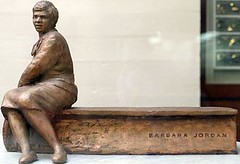
However, in August the statue committee rejected the design and are going to start over with new artists. The committee director and associate dean of students Sherri Sanders said they "need to look further to find a design that people could walk up to and be in awe."
Sheena Paul, a business senior at UT and chair of the statue committee, said "there had been concerns that the statue didn't quite convey her [Jordan's] presence, power or gravitas."
Mr. Crowley defended his statue design saying that it "was aimed at connecting with the student body. People going through the area could use the sculpture and sit next to her. The campus already has other overblown and oversized statues, and sculpturally, that's an unsophisticated way to go."
Although I appreciate the statue committee's dedication to the visability and appropriate representation of women and people of color, I resent the fact that they seem to be focused on making Jordan "fit in" more with the current statues to have gravitas. (Also, would the committee argue that the Confederate statues have gravitas?)
I agree with Mr. Crowley. Barbara Jordan isn't great because she looked like she could take out George Washington in a duel. She is great because she represented parts of America who often get overlooked. She's great because she connected with people.
The interesting part to me is that there is no discussion of Barbara Jordan's disability. In her 30's, while serving in the U.S. Congree, she was diagnosed with multiple sclerosis. Although she tried to keep it out of public view, she used a cane and then a wheelchair. This is why it especially bothers me that the committee is (or at least seems to be) pushing for a bigger, stronger, and more "normal" statue.
If it were up to me, we'd have a statue of Barbara Jordan in her wheelchair, sitting next to her lesbian life partner. But in the chance that that doesn't happen, I think we need different ways of thinking and talking about things. Where strength doesn't mean power. Where gravitas doesn't mean looking like the idols of the (rather white, rather male) past. Where you don't have to be big and tall to be awe-inspiring.
Most importantly, we need a realization that you don't have to be physically awe-inspiring to be respected. This is the only way we will ever break the marble ceiling for people with disabilities.
I will end by sharing one of my favorite poems by Lois Keith.
*Quotes and picture from The Daily Texan.
This quote from the soon-to-be speaker reminded me of the soon-to be Barbara Jordan statue at the University of Texas at Austin. At UT there are no statues of women and currently only one statue of a person of color (Martin Luther King, Jr). There are a lot of statues of Confederate war heros. The student body voted to break some marble ceilings, so to speak, and put some student fees towards building statues of Barbara Jordan and Ceasar Chavez. There were four finalists for the design of each statue. Students were able to view models of the finalists and pick the one they liked.
Of the four Barbara Jordan models, Kim Crowley's depiction, pictured below, was chosen. It shows Jordan sitting on a bench reaching into her breifcase. The statue was to be put near a path in an area with lots of trees.
However, in August the statue committee rejected the design and are going to start over with new artists. The committee director and associate dean of students Sherri Sanders said they "need to look further to find a design that people could walk up to and be in awe."
Sheena Paul, a business senior at UT and chair of the statue committee, said "there had been concerns that the statue didn't quite convey her [Jordan's] presence, power or gravitas."
Mr. Crowley defended his statue design saying that it "was aimed at connecting with the student body. People going through the area could use the sculpture and sit next to her. The campus already has other overblown and oversized statues, and sculpturally, that's an unsophisticated way to go."
Although I appreciate the statue committee's dedication to the visability and appropriate representation of women and people of color, I resent the fact that they seem to be focused on making Jordan "fit in" more with the current statues to have gravitas. (Also, would the committee argue that the Confederate statues have gravitas?)
I agree with Mr. Crowley. Barbara Jordan isn't great because she looked like she could take out George Washington in a duel. She is great because she represented parts of America who often get overlooked. She's great because she connected with people.
The interesting part to me is that there is no discussion of Barbara Jordan's disability. In her 30's, while serving in the U.S. Congree, she was diagnosed with multiple sclerosis. Although she tried to keep it out of public view, she used a cane and then a wheelchair. This is why it especially bothers me that the committee is (or at least seems to be) pushing for a bigger, stronger, and more "normal" statue.
If it were up to me, we'd have a statue of Barbara Jordan in her wheelchair, sitting next to her lesbian life partner. But in the chance that that doesn't happen, I think we need different ways of thinking and talking about things. Where strength doesn't mean power. Where gravitas doesn't mean looking like the idols of the (rather white, rather male) past. Where you don't have to be big and tall to be awe-inspiring.
Most importantly, we need a realization that you don't have to be physically awe-inspiring to be respected. This is the only way we will ever break the marble ceiling for people with disabilities.
I will end by sharing one of my favorite poems by Lois Keith.
Tomorrow I am going to rewrite the English Language.
I will discard all those striving ambulist metaphors of power and success
And construct new ways to describe my strength.
My new, different strength.
Then I won't have to feel dependent
Because I can't stand on my own two feet.
And I'll refuse to feel a failure
When I don't stay one step ahead.
I won't feel inadequate if I can't
Stand up for myself
Or illogical when I don't
Take it one step at a time.
I will make them understand that it is a very male way
To describe the world.
All this walking tall
And making great strides.
Yes, tomorrow I am going to rewrite the English Language
Creating the world in my own image.
Mine will be a gentler, more womanly way
To describe my progress.
I will wheel, cover and encircle.
Somehow I will learn to say it all.
*Quotes and picture from The Daily Texan.
Subscribe to:
Posts (Atom)